Our research asks how interactions and structural constraints shape the organization of complex systems across scales, their persistence and evolutionary change, and the emergence of innovations and transitions. We combine complex networks, statistical physics, evolutionary theory, mathematical and computational modelling, and empirical analysis, with approaches adapted to the biological, cultural and technological systems under study.
Biological organization, assembly and persistence
How does interaction structure shape the assembly, organization, dynamics and persistence of biological and ecological systems? Ecological networks provide a starting point for understanding how structural constraints and higher-order interactions influence assembly and persistence under non-equilibrium conditions. Nestedness and modularity are important features to explain within this broader question; networks and hypergraphs provide representations for studying the interactions involved.
These questions connect ecological organization with conservation and higher-order assembly with emergent persistence in biology. At the level of biological knowledge, Gene Ontology offers a way to trace changes in the modular and complex organization of representations of biological function.
- Hypergraphs in ecology link non-equilibrium dynamics and conservation — Communications Physics (2026).
- Higher-order assembly and emergent persistence in biology — Current Opinion in Systems Biology (2026).
- Structural changes in Gene Ontology reveal modular and complex representations of biological function — Molecular Biology and Evolution (2025).
Multiscale evolutionary dynamics and transitions
How do processes operating across different scales generate evolutionary stasis, gradual change, punctuated dynamics and transitions? Evolutionary tempo depends on the scale of observation: gradual change at one level can produce abrupt change at another. Comparing biological and cultural systems helps identify how feedbacks and external disturbances contribute to different forms of punctuated change.
This relation between scales informs the interpretation of punctuation in evolutionary anthropology and the broader study of evolutionary transitions. Current work on phylogenetic scaling and evolutionary transitions in mammalian intelligence extends these questions to the comparative evolution of cognition.
- On the multiscale dynamics of punctuated evolution — Trends in Ecology & Evolution (2024).
- The many ways toward punctuated evolution — Palaeontology (2024).
- Punctuated equilibrium at 50: Anything there for evolutionary anthropology? Yes; definitely — Evolutionary Anthropology (2024).
Cultural and technological evolution
How do cultural and technological systems generate novelty, acquire historical structure, diversify, and undergo turnover or collapse? Cultural transmission and the formation of artifact lineages connect the history of individual designs with the evolution of technological ecosystems. Software, programming languages, archaeological artifacts and arcade video games provide ways to examine how constraints, historical contingency and collaboration shape innovation and diversification.
Inheritance and recombination take different forms across these systems, shaped by their material and social dependencies. The rise and decline of technologies, and the changing relationships between software and computing hardware, connect the emergence of novelty with the persistence and turnover of complex artifacts.
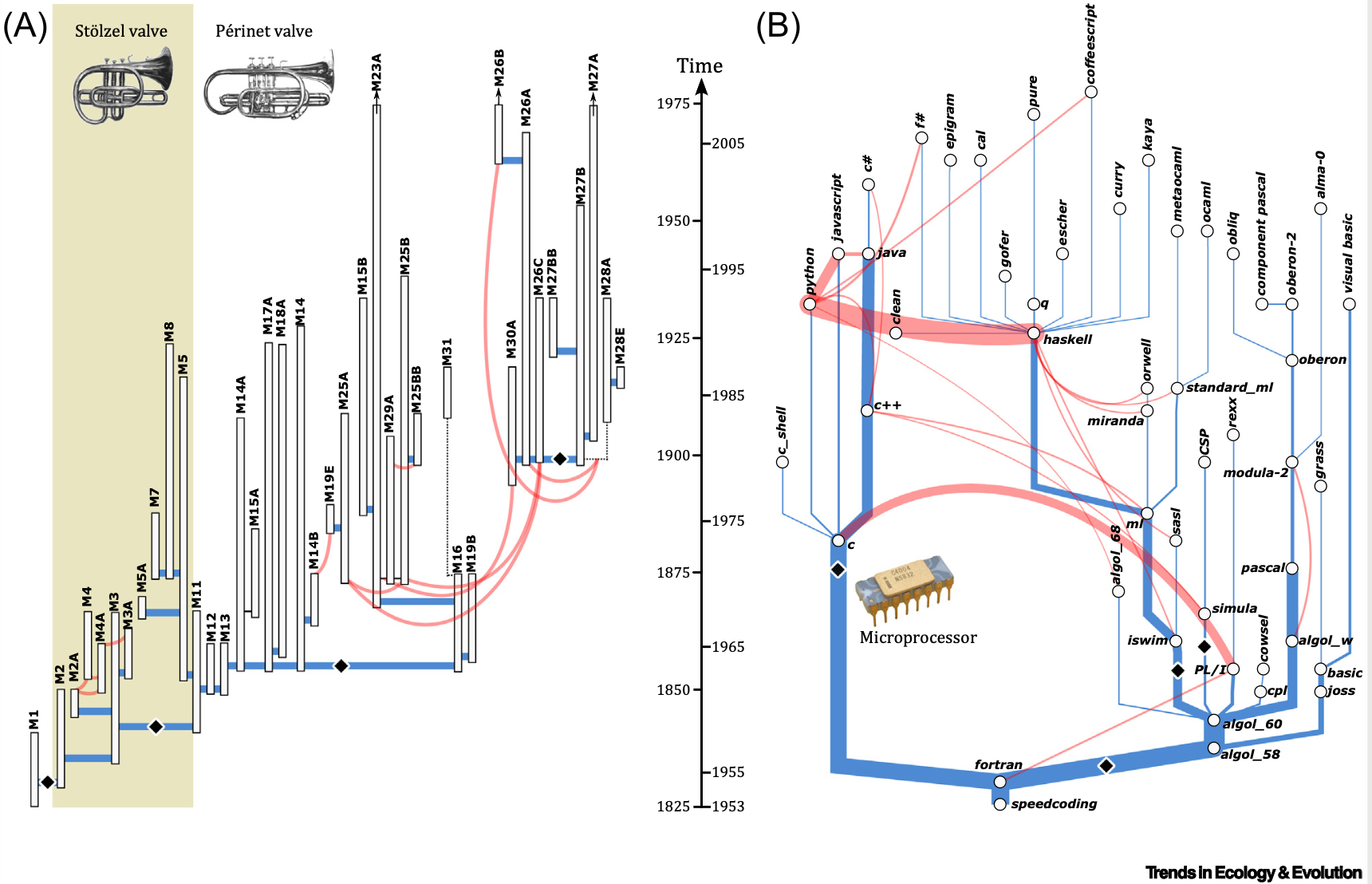
Watch “The Ascent of the Computer” — ECLT seminar on transitions in computing and the relationships between software, hardware and evolutionary constraints.
- The natural evolution of computing — Oxford Handbook of Cultural Evolution (2025 print edition).
- Archaeology and the construction of artifact lineages: From culture history to phylogenetics — Biological Theory (2025).
- The cultural macroevolution of arcade video games: Innovation, collaboration, and collapse — Evolutionary Human Sciences (2025).
- The evolutionary ecology of software: Constraints, innovation, and the AI disruption — The Economy as an Evolving Complex System IV (2026).
Spatial dynamics of innovation
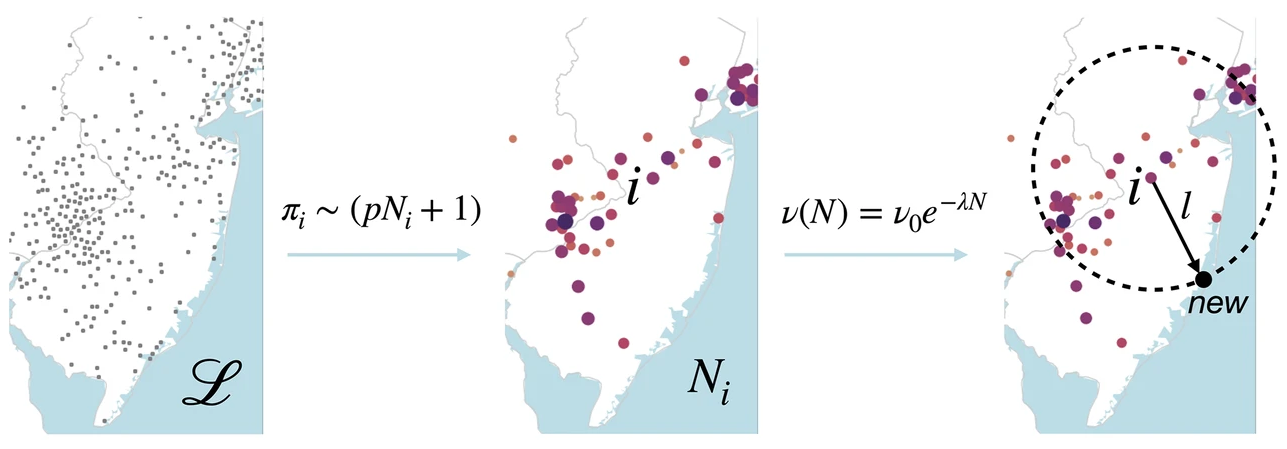
How does the geography of innovation emerge from interactions among people, ideas and places? More than a century of geolocated U.S. patent data reveals a geometry of innovation that extends beyond a few exceptional hubs. Patent activity follows scaling patterns, with productive centres embedded in a hierarchy of smaller and larger clusters. This fractal organization repeats across spatial scales, forming a structured landscape whose inequalities depend on how closely we look.
An “inequality horizon”, around 20 kilometres in these data, marks the scale of strongest spatial disparity; differences diminish as clusters merge into larger regions. To explore how this organization can arise, a minimal model combines local reinforcement, which favours places with existing activity, with occasional long-range dispersal that seeds new locations. Together, cumulative advantage and dispersal reproduce the observed patterns, offering a simple mechanism for the emergence of spatial organization.
- Duran-Nebreda, S., Vidiella, B., Bentley, R. A., & Valverde, S. Fractal clusters and urban scaling shape spatial inequality in U.S. patenting — npj Complexity, 2, 30 (2025).